A morning walk through the last coastal forest fragments of Diani, following the troops of endangered black-and-white colobus monkeys that live in the canopy above. Every step you take here funds their protection.
Most guests at Diani have already seen colobus monkeys — the striking, long-tailed primates with black fur and white mantles that leap between the trees along the beach road. What most guests do not know is that these animals are endangered, that their forest habitat is shrinking year by year, and that a small, dedicated organisation on Diani Beach Road has been fighting to protect them for over three decades.
The Colobus Conservation Trust was established in 1997 to address the escalating human-wildlife conflict caused by rapid development along the Diani coast. Roads cut through forest corridors. Power lines electrocute primates. Hotels and houses replace the trees they depend on. The Trust runs a rescue and rehabilitation centre, builds rope bridges across roads (the famous "colobus bridges"), operates a wildlife ambulance, and conducts long-term population monitoring. It is community-based conservation at its most practical and effective.
The walking tour begins at the Trust's centre on Diani Beach Road, where a trained local naturalist introduces the three primate species you will encounter: the Angolan black-and-white colobus (Diani's flagship species), the Sykes' monkey, and the vervet monkey. From there, you walk into the adjacent coastal forest patches — the very habitat the Trust is working to protect — scanning the canopy for colobus troops. Your guide explains their behaviour, diet, social structure, and the conservation challenges they face. The tour concludes with a visit to the rescue and rehabilitation centre, where injured primates — often victims of road accidents, electrocution, or dog attacks — are treated, rehabilitated, and released back into the forest.
Rare primates, real conservation, and a morning that changes how you see the world outside your hotel.
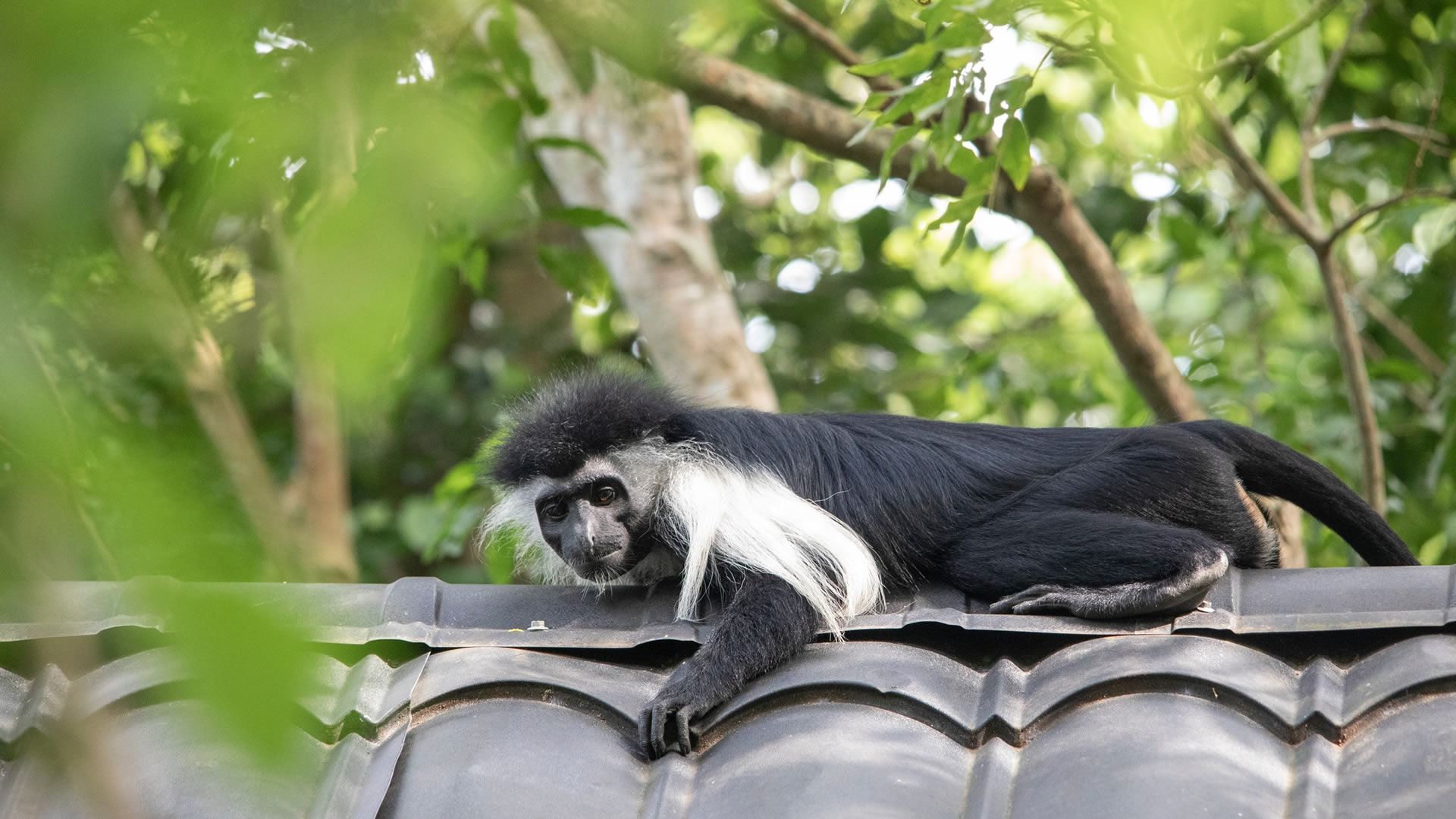
The Angolan black-and-white colobus is one of Africa's most beautiful primates — glossy black fur, flowing white mantle, and a spectacular long white tail. Diani's population is one of the last viable groups on the Kenya coast, and they live in the trees directly around you.
The Trust has installed over 500 rope bridges across Diani's roads — "colobridges" that allow primates to cross safely above traffic instead of on the ground. You will see them strung between trees along the beach road. They have reduced primate road deaths dramatically.
Visit the facility where injured primates are treated, nursed back to health, and released. The Trust's wildlife ambulance responds to calls from residents and hotels across Diani. You will meet the team, see the facilities, and understand the daily reality of frontline conservation.
The guided walk takes you through remnant patches of Diani's indigenous coastal forest — the same habitat that once covered the entire coast. Your naturalist identifies trees, birds, butterflies, and the subtle signs of primate activity in the canopy above.
This is not a zoo visit. It is an immersion in real-world conservation — the challenges, the successes, the setbacks, and the people who dedicate their lives to protecting Diani's wildlife. Particularly powerful for children, who leave with a genuine understanding of what conservation means in practice.
Every shilling of your tour fee goes directly to the Colobus Conservation Trust's programmes — rescue operations, veterinary care, bridge construction, habitat protection, and community education. This is not a donation box afterthought. Your visit is the funding model.
A relaxed, accessible morning walk — minimal preparation needed.
Comfortable walking shoes (trails can be uneven), insect repellent, binoculars for canopy viewing, camera with a zoom lens, light long sleeves for sun and insect protection. A hat and sunscreen are useful for open sections.
Easy and family-friendly. Light walking on forest trails with some uneven ground but no steep terrain. The pace is gentle — you stop frequently to observe primates and listen to your guide. Manageable for all fitness levels. The centre itself is on flat ground.
Particularly recommended for families. Children love watching the monkeys leap between trees and are fascinated by the rescue centre. The guides are excellent with younger visitors and make the conservation message engaging and age-appropriate. Educational and fun in equal measure.
Stay on designated trails. Do not feed or attempt to touch the monkeys — they are wild primates. Maintain the distance your guide recommends. Flash photography can startle animals; use natural light where possible. Your guide will position the group for the best viewing opportunities.
Early morning (07:30–08:00 start) is strongly recommended. Colobus monkeys are most active in the first hours of the day, moving through the canopy to feed. Afternoon walks are available but primate activity is typically lower during the heat of the day.
Year-round — the Trust operates daily regardless of season. Light rain does not cancel tours (and the forest canopy provides good shelter). Heavy downpours may delay a walk briefly. Colobus monkeys are resident and active every day — there is no seasonal variation in sighting probability.
The Colobus Conservation Trust is a community-based, non-profit organisation. 100% of tour proceeds fund the Trust's rescue, rehabilitation, and habitat protection programmes. Since its founding in 1997, the Trust has installed over 500 primate rope bridges across Diani, responded to thousands of wildlife emergency calls, treated and released hundreds of injured primates, and conducted continuous population research. By visiting, you are not observing conservation — you are paying for it. Additional donations fund specific projects: a colobus bridge costs approximately USD 300 to build and install; veterinary treatment for an injured primate ranges from USD 50 to USD 500. Ask your guide how you can contribute further.
Let us know your date — we'll arrange a morning walk with the Trust's expert naturalists.
Book This WalkSightings are very likely — the colobus troops are resident in the forest patches around the Trust and are active every day. Your naturalist guide knows their home ranges and daily movement patterns. Morning walks offer the highest probability as the monkeys are feeding and moving through the canopy. You will almost certainly also see Sykes' monkeys and vervets. However, these are wild animals in a natural forest — sightings cannot be absolutely guaranteed on every walk.
No. The Colobus Conservation Trust is a conservation organisation, not a zoo. The primates you see on the forest walk are wild, free-ranging animals in their natural habitat. The rescue centre houses only temporarily injured or orphaned animals that are being treated and rehabilitated for release back into the forest. The Trust's entire mission is to keep these animals wild and to protect the habitat they depend on.
Directly and meaningfully. 100% of your tour fee goes to the Trust's programmes: wildlife rescue and veterinary care, colobus bridge construction and maintenance, habitat protection, population research, and community education. Tourism revenue is the primary funding source for these programmes. Additional donations are always welcome — ask your guide about specific projects you can sponsor, such as a rope bridge (approximately USD 300) or veterinary treatment for an injured primate.
Rope bridges — "colobridges" — are the Trust's signature conservation innovation. Made from heavy-duty rope and suspended between trees on either side of a road, they provide a safe aerial crossing for primates who would otherwise have to descend to the ground and cross roads, where they are frequently hit by vehicles. Over 500 bridges have been installed across the Diani area. They have significantly reduced primate road fatalities. You will see several along the beach road during your tour.
Absolutely — it is one of the best excursions on the coast for families. Children are fascinated by watching the monkeys leap and swing through the canopy, and the rescue centre gives them a tangible understanding of why wildlife protection matters. The guides are excellent with younger visitors and pitch the conservation message at an accessible level. The walk is short, gentle, and engaging enough to hold even a young child's attention.
Yes — the walk takes only 1.5 to 2.5 hours, leaving most of the day free. The most popular pairings are: Kaya Kinondo Sacred Forest (a second morning forest experience, 15 minutes away), Kongo River Sunset Cruise (forest morning, sunset evening), and an afternoon at the beach. It also pairs well with the Ukunda Village Walk if you want a full morning of community and nature experiences before lunch.